


High Temperature Neodymium Magnets: H, SH, UH and EH Grades Explained
Date
29 June 2026
Category
Author
Conal McLaughlin
Standard neodymium magnets offer excellent magnetic strength at room temperature, but they are not always suitable for applications exposed to elevated temperatures.
This is important for engineers specifying magnets for motors, sensors, generators, magnetic couplings, holding systems or assemblies near heat sources.
The key issue is not simply “how strong is the magnet?” It is whether the magnet can retain enough magnetic performance at the real working temperature of the application.
High temperature neodymium magnets are designed for this purpose. These grades use higher intrinsic coercivity to resist demagnetisation as temperature rises, making them suitable for applications where a standard N-grade magnet would lose performance or fail prematurely.
This article explains how high temperature NdFeB grades work, why standard N grades are usually limited to around 80°C, and how to choose between H, SH, UH and EH grade families.
Why standard N-grade neodymium magnets fail above 80°C
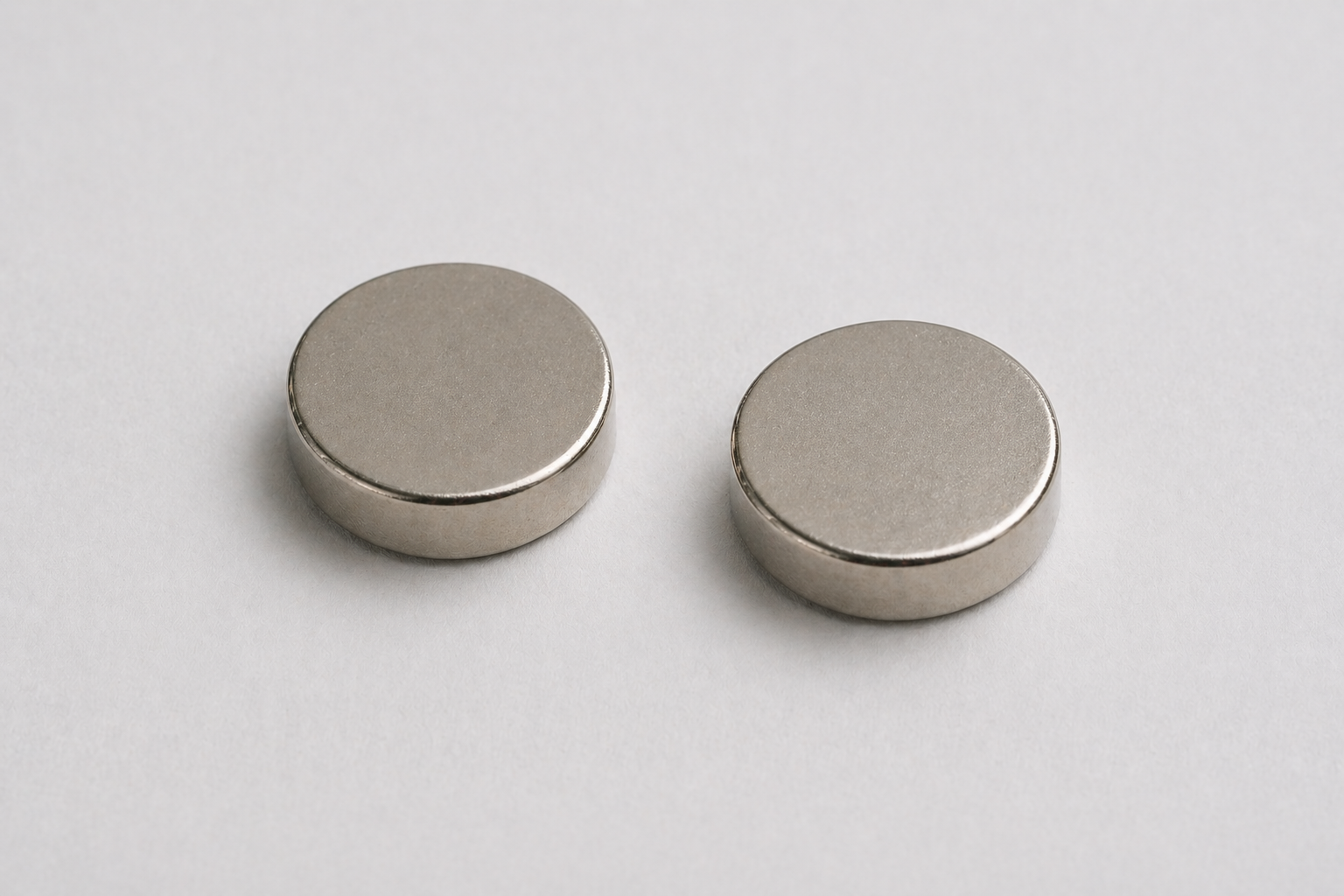
Most standard neodymium magnets are identified by an N grade, such as N35, N42, N48 or N52. The number refers to the magnet’s maximum energy product, or BHmax, which indicates the magnetic strength available from the material.
These standard N grades are extremely strong at room temperature, but they usually have a maximum operating temperature of around 80°C.
Above this point, the magnet becomes increasingly vulnerable to irreversible demagnetisation.
This does not mean the magnet simply becomes weaker while hot and then fully recovers when cooled. If the working temperature, magnetic circuit, geometry or opposing fields push the magnet beyond its safe operating range, some of the magnetic loss can be permanent.
This matters in applications such as:
- Electric motors and generators
- Automotive sensors and actuators
- Magnetic couplings
- Assemblies close to engines, heaters or process equipment
- Industrial handling or holding systems exposed to heat
- Electronics or instrumentation where field consistency is important
A standard N52 magnet may look attractive because of its high room-temperature strength, but it is often the wrong choice where temperature stability is more important than maximum pull force in ambient conditions.
How high temperature NdFeB grades are different
High temperature neodymium magnets are still NdFeB magnets, but they are manufactured to provide higher resistance to demagnetisation.
This is usually achieved by increasing the intrinsic coercivity of the material. In practical terms, elements such as dysprosium are added to improve the magnet’s ability to resist magnetic loss at elevated temperatures.
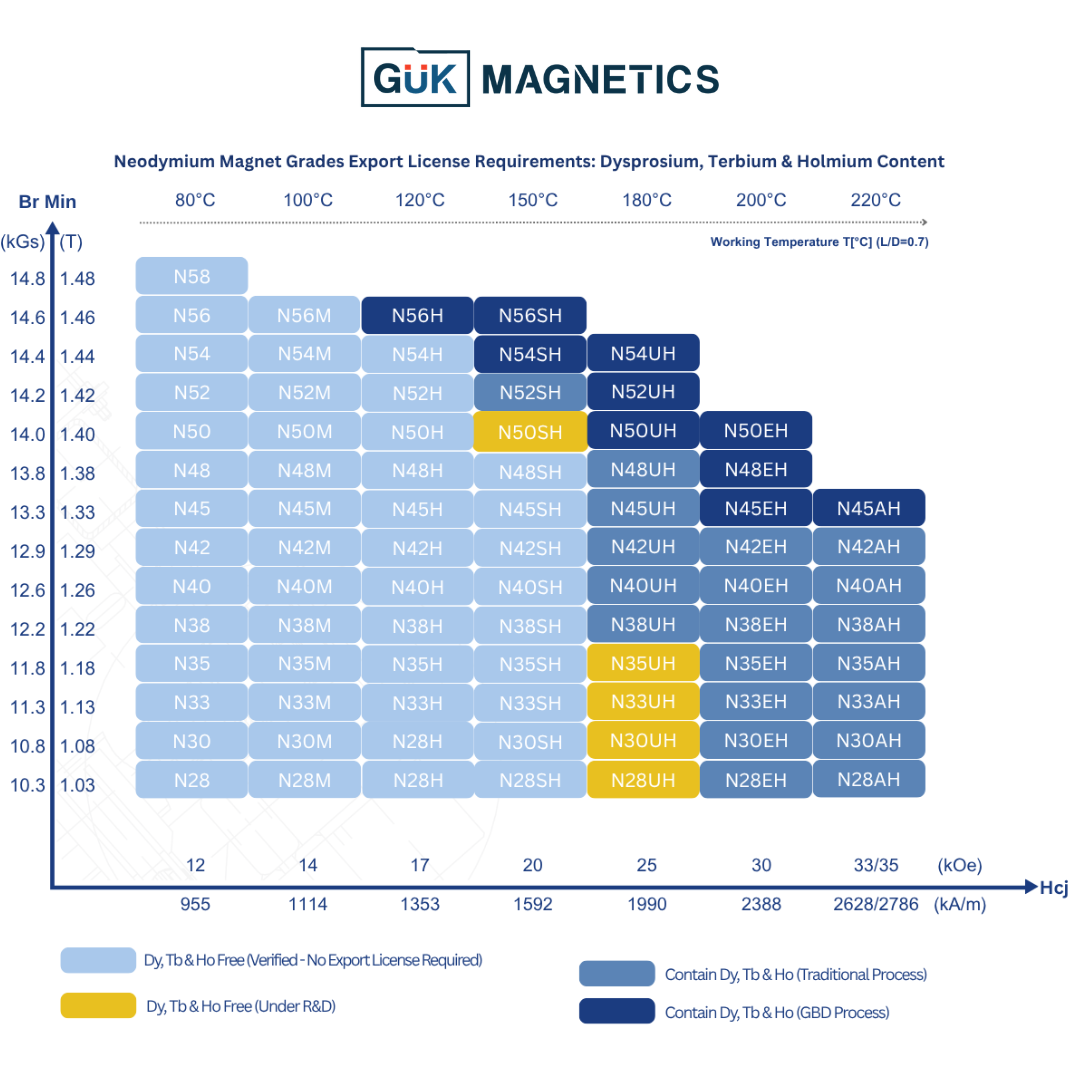
The grade suffix indicates the temperature-rated family. Common examples include:
N: Up to 80°C
M: Up to 100°C
H: Up to 120°C
SH: Up to 150°C
UH: Up to 180°C
EH: Up to 200°C
AH: Up to 220°C
These figures are useful as a guide, but they should not be treated in isolation. The true safe working temperature depends on the magnet shape, size, grade, coating, assembly design and magnetic circuit.
For example, a long magnet in a favourable closed magnetic circuit may tolerate conditions better than a very thin magnet exposed to a strong opposing field. This is why temperature grade selection should always consider the full application, not just the headline temperature figure.
The trade-off: why higher temperature tolerance usually means lower BHmax
A common mistake is assuming that the highest temperature-rated grade is automatically the best option. In reality, high temperature performance comes with trade-offs.
Adding dysprosium improves coercivity and thermal stability, but it can reduce remanence and maximum energy product. This means a high temperature grade may have lower magnetic strength than a standard N grade of a similar number.
For example, a standard N52 magnet offers very high magnetic strength at room temperature, but it is not suitable for many elevated-temperature applications. A grade such as N42SH, N38UH or N35EH may provide lower room-temperature strength, but it will retain its performance more reliably when exposed to heat.
The correct choice is therefore not always the strongest magnet. It is the grade that gives the required magnetic performance at the operating temperature of the application.
Important Consideration: Higher temperature NdFeB grades rely on increased dysprosium content to improve coercivity, making them more likely to be affected by rare earth export licence requirements and associated supply chain considerations. See our Export License Guide for full details.
H, SH, UH and EH grades: when each is used
H grades
H grades are commonly used where the application exceeds the limit of standard N grades but does not involve extreme heat. They are often suitable for working temperatures up to around 120°C.
Typical uses include general industrial assemblies, sensors, equipment near moderate heat sources and applications where a standard N grade would be marginal.
SH grades
SH grades offer a further step up in temperature resistance, typically up to around 150°C. They are often used in motors, generators, actuators and industrial systems where the magnet may experience sustained elevated temperature.
SH grades are a common choice when the design needs a balance between magnetic performance, availability and thermal stability.
UH grades
UH grades are selected for more demanding applications, typically up to around 180°C. These are suitable where high coercivity is essential and where the risk of irreversible demagnetisation is greater.
UH grades are often considered for higher-performance motors, magnetic couplings, automotive applications and assemblies exposed to more severe operating conditions.
EH grades
EH grades are used where very high temperature resistance is required, typically up to around 200°C. They are more specialised and may involve greater cost, longer lead times or more limited availability depending on size, geometry and specification.
EH grades are typically specified when the design cannot tolerate field loss and where the operating temperature rules out lower coercivity options.
Choosing the correct neodymium grade
In practice, the correct grade is often a compromise between magnetic performance, coercivity, cost, availability and export documentation. For example, an engineer may request a high-remanence EH grade because it meets a high Hcj requirement, but the application may still need review to confirm whether a lower coercivity grade could work without adding unnecessary cost, lead time or export licence complexity.
Coating still matters at high temperature
Temperature grade is only part of the specification. NdFeB magnets are vulnerable to corrosion, so coating selection remains important, particularly in humid, outdoor, chemically exposed or cyclic-temperature environments.
Common coatings include nickel-copper-nickel, epoxy, zinc and other specialist finishes. However, the coating must also be suitable for the application temperature and environment.
For example, a high temperature magnet with an unsuitable coating may still fail through corrosion or coating breakdown, even if the magnetic grade itself is appropriate.
When specifying high temperature neodymium magnets, engineers should consider both magnetic performance and environmental protection together.
For more information, view our neodymium magnets coating guide.
How to specify a high temperature neodymium magnet
When requesting a quote or technical recommendation, it helps to provide as much application detail as possible. Useful information includes:
- Required grade or performance target
- Maximum operating temperature
- Continuous and peak temperature exposure
- Magnet shape and dimensions
- Magnetisation direction
- Coating or environmental requirements
- Required quantity
- Whether the magnet is used in an assembly
- Any existing drawing, tolerance or material specification
If the current grade is failing, it is also helpful to explain the failure mode. For example, whether the magnet is losing strength after heat exposure, corroding, cracking, detaching from an assembly or underperforming in the magnetic circuit.
GUK Magnetics supply capability
GUK Magnetics supplies neodymium magnets across standard and high temperature grade families, including H, SH, UH and EH options.
We support engineers and procurement teams with grade selection, coating options, magnetisation direction, shapes and manufacturability considerations. Where required, we can also supply magnets as part of magnetic assemblies or engineered component solutions.
Our role is to help you specify a magnet that suits the real operating conditions of the application – not simply the strongest magnet on paper.
Need high temperature neodymium magnets?
If your application operates above 80°C, a standard N-grade neodymium magnet may not be suitable.
GUK Magnetics can help you identify the right high temperature NdFeB grade based on your working temperature, required magnetic performance, coating needs and application environment.
Send us your drawing, specification or application details and we’ll advise on suitable high temperature neodymium magnet options.