Engineered Components
Custom-manufactured metal and plastic components
produced to your exact specifications.

Engineered Components
ALUMINIUM & ZINC DIE CASTING
GUK Magnetics supplies medium to high volume aluminium and zinc die cast components for manufacturers and industrial environments requiring repeatability, controlled tolerances and long-term supply reliability.
We manage the complete die casting process — from manufacturability review and tooling validation through to post-cast CNC machining, finishing and ongoing production. Whether you require a high-volume housing or a complex casting with tight secondary machining tolerances, we provide UK-based engineering oversight and quality control at every stage.
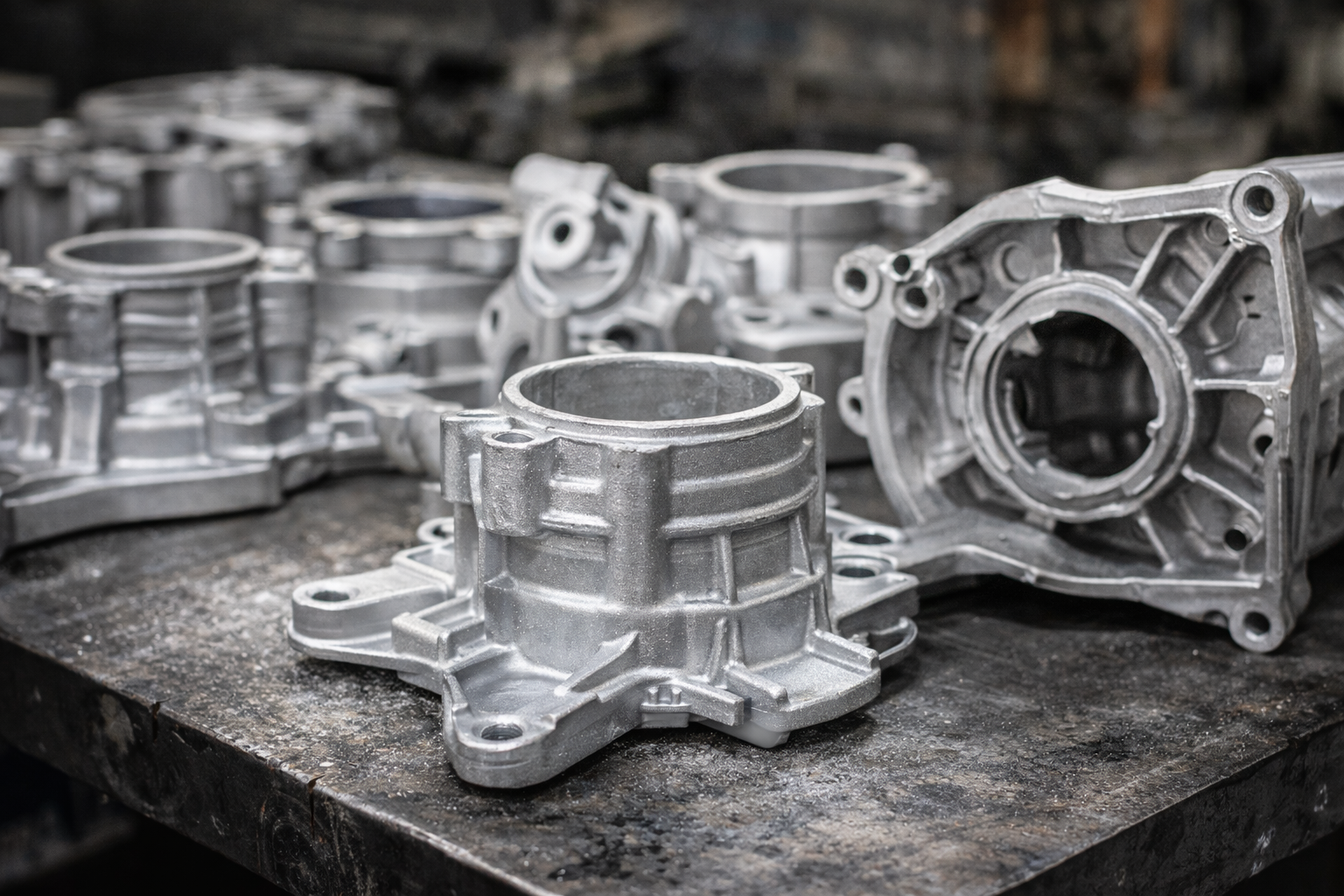
ALUMINIUM & ZINC DIE CASTINGS
High-quality cast components for demanding industrial applications including housings, brackets, motor components, enclosures, structural frames and thermal management parts.
COMPLEX & THIN-WALL GEOMETRIES
Suitable for intricate forms and controlled wall thickness designs.
MEDIUM TO HIGH-VOLUME PRODUCTION
Optimised for repeat orders and long production runs where tooling investment delivers consistent cost efficiency.
TOOLING DESIGN & VALIDATION
Right-first-time tooling supported by controlled trial and sampling processes before full production release.
POST-CAST MACHINING & FINISHING
Multi-axis CNC machining to achieve tight tolerances, threaded features, precision bores and critical mating surfaces.
ISO 9001-CERTIFIED QUALITY SYSTEM
Documented inspection, dimensional verification and traceability throughout development and production.
Materials, Finishing & Post-Cast Machining
Selecting the correct aluminium or zinc alloy determines the mechanical strength, weight, corrosion resistance and thermal performance of your component. Because all die cast parts display natural process witness marks, surface finish should be considered early to achieve the required performance and appearance.
Where tighter tolerances or complex features are needed — such as threads, non-aligned holes or undercuts — post-cast CNC machining ensures final dimensional accuracy and repeatable results. If you’re unsure on the best approach, our team can advise on alloy selection and manufacturability.
-
Materials & Alloys
We supply aluminium and zinc die castings. Common alloys include:
- Aluminium and Zinc
-
Alloy 3, 5, and 7
-
A360
-
380 / A380
-
ZA-8
-
ZA-12
-
Finishing & Cosmetic
Available finishing processes include:
-
Shot blasting and bead blasting
-
Vibratory tumbling
-
Nickel plating and chromate conversion
-
Powder coating and painting
-
-
Post-Cast CNC Machining
-
Multi-axis CNC milling and turning
-
Threads, undercuts and non-standard hole orientations
-
Tighter tolerances than casting alone
-
Improved repeatability over manual machining
-
Press-fit inserts for high-load or threaded zones
-
Machining of critical faces and interfaces
-
ISO 9001-certified quality
Die cast components are inspected throughout development and production to verify:
-
Dimensional accuracy
-
Surface finish
-
Casting integrity (porosity, cold casting)
Quality documentation is supplied as part of the sample approval and production process. All work is supported by our ISO 9001-certified quality system.
FAQs
Our dedicated team is always ready to assist you with any additional requirements.
Contact UsGeneral casting tolerances are process-dependent. Critical dimensions can be controlled more tightly using post-cast CNC machining.
Die cast parts often show small marks or seams caused by how the metal is injected and released from the tool. These are normal and part of the process, but they can be reduced or improved through finishing.
What to Expect on a Die Cast Part:
-
Gates and vents are needed to let metal in and air out — these will leave small marks.
-
Ejector pins help push the part out of the tool — they also leave visible circles or dents.
-
Flash is thin excess metal around split lines that appears where the tool separates.
How We Improve the Finish:
-
Clipping removes the larger metal feed and vent points after casting. This can be done mechanically or hydraulically.
-
Because casting alloys don’t break as cleanly as steel, some small leftover marks (called “witness”) are normal.
-
If a cleaner finish is needed, we can machine the area using CNC to smooth it out.
Surface Finishing Options:
After clipping, we can further improve the part’s appearance using:
-
Shot blasting or tumbling to smooth sharp edges and reduce flash
-
Powder coating to apply colour and cover minor marks
-
Nickel plating or chromate coating for corrosion protection
Note: Die cast parts don’t anodise well, and over time the surface may darken from oxidation. A surface finish is recommended for appearance and protection.
Tooling timelines depend on complexity but typically range from 6–10 weeks including sampling and validation.
While die casting offers rapid, near-net-shape metal production, not all features can be formed in the die itself. Some must be machined after casting to achieve the required function or tolerance.
Design Limitations for Casting
Some features are better suited to post-cast machining, such as:
-
Holes not aligned with the split line
-
Parallel-sided features (draft is required for ejection)
-
Threads, especially if the axis is not along the split line
-
Undercuts or complex internal forms
CNC Machining Capabilities
-
GUK Magnetics offers multi-axis CNC milling and turning to finish components to specification.
-
CNC provides high repeatability and is used for nearly all post-cast machining.
-
This enables tight tolerances and complex geometries that can’t be achieved through casting alone.
Insert Features and Strength Zones
-
High-load features (e.g. tapped bosses) may require added strength.
-
Press-fitting stainless steel inserts is often preferable to casting around them.
-
Some components (e.g. motor shafts) can be cast around, depending on design.
Precision CNC Turning & Milling services
GUK Magnetics provides high-precision CNC machining services, supplying custom-machined components manufactured to customer specifications. We supply both stand-alone CNC machined parts as well as CNC-machined components to support magnetic assemblies.
We have over 25 years’ experience supporting customers across automotive, medical, aerospace, oil & gas, and industrial manufacturing – delivering accurate, repeatable, and production-ready components for demanding applications.
CNC turning from 4 mm to 360 mm
Small precision parts through to large turned components
CNC milling capacity up to 1 m × 1 m
Suitable for large plates, housings and structural components
3-axis, 4-axis and 5-axis machining
Complex geometry with fewer setups and improved accuracy
mid to high-volume production
Optimised for repeat orders and consistent batch quality
Wide range of finishing and secondary operations
Fully finished, application-ready components from one supplier
ISO 9001 certified quality system
Controlled processes, inspection and documented traceability
CNC Turning
We manufacture precision CNC turned components with varying tolerance requirements depending on material, geometry, and application.
All orders are supported by responsive UK-based support, clear communication on lead-times and reliable supply and delivery – certified to ISO 9001 standards.
Typical CNC turned components include shafts, sleeves, spacers, bushings, retainers, threaded and stepped parts.
-
CNC Turning capability
-
Diameter range: 4 mm – 360 mm
-
Single-spindle, single-turret machines
-
8–12 tool configurations
-
Increased coolant capacity, chip conveyors, and parts catchers
-
Typical production runs from 5,000 to 15,000+ components
-
-
Range of materials
- Aluminium alloys
- Mild and carbon steels
- Stainless steels
- Brass
- Selected specialist alloys on request
-
ISO 9001 Certified
CNC Milling
Our CNC milling capability supports both simple prismatic parts and more complex geometries, with 3-axis machining as standard and 4- and 5-axis machining available depending on volume and application.
Components are machined to engineering drawing requirements, with tight tolerances supported where required depending on material and geometry. CAM programming is used to optimise tool paths, reduce cycle times, and maintain consistent quality.
All orders are supported by responsive UK-based support, clear communication on lead-times and reliable supply and delivery – certified to ISO 9001 standards.
-
CNC Milling capability
- Maximum component size of approximately 1 m × 1 m
- A range of bed sizes and spindle speeds
- Support for complex profiles, pockets, and interfaces
- Suitable for both standalone parts and assembly components
-
Range of materials
- Aluminium alloys
- Mild and carbon steels
- Stainless steels
- Brass
- Selected harder or specialist materials on request
-
ISO 9001 Certified
Comprehensive range of finishing techniques and secondary operations
We offer a comprehensive range of finishing and secondary operations to deliver fully finished, application-ready components. Available processes include:
Tumbling ♦ Deburring ♦ Polishing ♦ Bead blasting ♦ Sand blasting ♦ Electroplating ♦ Anodising ♦ Passivating ♦ Powder coating ♦ Painting ♦ Mechanical assembly
Our team can advise on the most appropriate finish based on performance, corrosion resistance, and aesthetic requirements.
Stringent Quality Control & Inspection
We maintain strict quality control standards with advanced metrology and testing equipment. Our Mitutoyo CMM machines enable automated precision measurement, while computer-based vision systems provide thorough quality verification.
Additionally, we conduct hardness and tensile strength testing to validate durability and geometric tolerance inspections to guarantee each component meets stringent industry requirements.
FAQs
Our dedicated team is always ready to assist you with any additional requirements.
Contact UsWe provide CNC milling and turning, supporting both standard and complex geometries. This includes 3-axis machining as standard, with 4-axis and 5-axis machining available where required, as well as precision CNC turning for rotational components.
We commonly machine aluminium, mild steel, stainless steel, and brass, with selected harder or specialist alloys available on request. Material suitability is reviewed alongside tolerances, geometry, and production volume.
Components are machined to engineering drawing requirements, with tight tolerances supported where required depending on material, geometry, and process. All parts are inspected using in-house metrology and CMM systems to verify dimensional compliance.
We support mid to high-volume production, including repeat orders and ongoing supply. Typical production runs range from small batches through to 5,000–15,000+ components, with lower volumes supported where required.
Quality is assured through an ISO 9001-certified quality system, supported by automated Mitutoyo CMM inspection, vision systems, geometric tolerance verification, and hardness, tensile, and material composition testing.
Yes. We offer a wide range of finishing and secondary processes, including deburring, polishing, bead blasting, anodising, passivation, electroplating, powder coating, painting, and mechanical assembly.
Metal Injection Moulding for Precision Engineered Components
GUK Magnetics supplies Metal Injection Moulding (MIM) components for medium to high-volume production. The process is suited to small, complex metal parts where conventional machining or casting would be inefficient or cost-prohibitive.
MIM combines fine metal powders with injection moulding technology to produce near net-shape components with controlled shrinkage and typical tolerances of ±0.3%. Secondary machining can be incorporated where tighter tolerances are required. We support standalone MIM components as well as parts integrated into magnetic assemblies and engineered systems.
High-Volume Net-Shape Production
Metal Injection Moulding is ideal for complex, small components produced at medium to high volumes. Once tooling is established, part cost remains stable - even with intricate geometry.
Broad Material Capability & Guidance
We supply MIM components in stainless steels, low alloy steels, tool steels and soft magnetic alloys & provide guidance on material selection.
Engineering-Led Design Review
Every MIM project is reviewed for manufacturability, shrinkage control and tolerance feasibility before tooling is committed.
ISO 9001 Certified Quality Management
GUK Magnetics operates under an ISO 9001 certified quality management system, ensuring controlled processes, traceability and consistent production standards.
Precision & Repeatability Guaranteed
Typical tolerances of ±0.3% are achievable, with tighter tolerances supported through post-sinter CNC machining where required.
Integrated Component Supply
We don’t just supply standalone parts. We support components that integrate with magnetic assemblies, housings and wider mechanical systems - reducing supplier complexity.
Materials Available for MIM
| A | B | C | D | E | F | G | |
|---|---|---|---|---|---|---|---|
| Stainless Steel | Soft Magnetic Alloy | Low Alloy Steel | Tool Steel | Special Alloy | Plastic | Ceramic | |
| 17-4PH | FeSi3 | FN04 | M2 | Ti | PA | Al2O3 | |
| 316L | FN50 | FN08 | SKD11 | W | PPS | ZrO2 | |
| 304 | FeCo35 | G1010 | F15 | ABS | |||
| 420 | FeCo50 | 8620 | HX | PE | |||
| 430 | 8740 | N90 | PS | ||||
| 440B | 4340 | GHS-4 | POM | ||||
| 440NB | 100Cr6 | LCP | |||||
| 42CrMo4 | |||||||
| SCM415 |
Metal Injection Moulding Applications
Our Metal Injection Moulding components are used across demanding production environments where precision, repeatability and material performance are critical. From automotive systems to medical instruments and consumer electronics, MIM enables complex geometries at scale.
We manufacture to customer drawings and specifications. If required, we can review your design for manufacturability, shrinkage behaviour and tolerance feasibility prior to tooling commitment.
FAQs
Our dedicated team is always ready to assist you with any additional queries or requirements you may have.
Contact UsTypical dimensional tolerances are:
-
±0.3% of nominal dimension (common)
-
±0.5% depending on geometry and material
Where tighter tolerances are required, secondary CNC machining can be applied.
MIM is best suited to:
-
Small, intricate components
-
Thin wall geometries
-
Parts typically under 100g
It is particularly effective where multiple machining operations would otherwise be required.
MIM components are widely used in:
-
Automotive systems (gearbox components, seat mechanisms, starter parts)
-
Medical devices (surgical instruments, tweezers, forceps)
-
Consumer electronics (SIM trays, key components, precision housings)
-
Industrial tooling and assemblies
Yes. One of the key advantages of MIM is process consolidation.
Several operations — such as threading, marking, weight optimisation, and complex geometries — can be combined into a single moulded part, reducing:
-
Secondary operations
-
Assembly steps
-
Lead time
-
Total manufacturing cost
MIM may not be appropriate for:
-
Very low production volumes
-
Very large or heavy components
-
Extremely simple geometries where machining is more economical
We review drawings and volume projections to determine suitability.
Thermoplastic Moulded Components Manufactured to Specification
GUK Magnetics specialises in the volume manufacture of thermoplastic injection moulded components. We focus on the industrialisation of your design – ensuring parts are dimensionally stable, visually consistent and production-ready.
We manufacture to customer drawings and specifications. Where required, we support manufacturability refinement prior to tooling to reduce risk and ensure predictable performance in application. We offer a wide range of post moulding options and can assemble multiple components to create your final product
Manufacturability Guidance
We review every component prior to tooling commitment, providing guidance on draft angles, wall thickness, shrinkage behaviour and assembly features to ensure reliable production from the outset.
FEA & Mould Flow Simulation
Where required, our manufacturing partners can perform mould flow, mechanical load and thermal analysis to validate performance before steel is cut - reducing development risk and costly tool revisions.
Hardened Tool Steel Tooling
Tools are manufactured by specialist partners from hardened tool steel, with typical lifespans of 200,000–500,000 shots. Complex tools with slides, cores and hot runners are routinely supported.
Broad Engineering Polymer Range
We mould standard and high-performance polymers including PA, ABS, POM, PPS and PEEK, with options for glass-filling, flame retardancy and UV stabilisation.
Insert & Two-Shot Moulding
Metal inserts and multi-material components can be integrated within a single moulding process — reducing part count and simplifying assembly.
Post-Moulding & Assembly
Ultrasonic welding, machining, printing and finishing operations are available. We also assemble moulded components into complete sub-assemblies where required.
Polymers & Material Selection
We support a wide range of thermoplastics selected according to mechanical load, environmental exposure and regulatory requirements. Clear components can be produced from highly polished tooling where required.
Rubber materials including EPDM, silicone, nitrile and neoprene can also be moulded. Material selection is guided by performance requirements and cost/performance optimisation.
-
Common polymers include:
-
Nylon (PA)
-
ABS
-
LDPE
-
HIPS
-
Acetal (POM)
-
-
Engineering and high-performance materials available:
-
PEEK
-
PC
-
PS
-
FDA-approved grades
-
-
Polymers may be modified for:
-
UV stability
-
Flame retardancy
-
Glass fibre reinforcement
-
Mineral or bead filling
-
Tooling
Tool design and construction are critical to successful injection moulding. GUK maintains but does not manufacture tooling in-house, instead working with specialist partners to produce hardened tool steel tools built for durability and precision. Typical tool life ranges from 200,000 to 500,000 shots, depending on complexity and material selection. Complex tooling solutions are routinely supported, including slides, rotating cores, hot runner systems and multi-cavity configurations.
Gate selection and ejection methods are determined by part geometry and performance requirements. Options include sprue, edge, film, diaphragm and tunnel gating, with pin, sleeve, blade or stripper plate ejection systems available where required. Cooling and venting strategies are carefully optimised to ensure dimensional stability, surface quality and repeatable production performance.
INTEGRATION, POST-MOULDING OPERATIONS & FINISHING
In addition to standard moulding, we support integrated manufacturing solutions including insert and two-shot moulding to consolidate components within a single production process.
Machined or stamped metal inserts can be overmoulded with polymer, while multi-material moulding enables structural and elastomeric features to be combined within one part – reducing assembly complexity and improving consistency.
We also offer a comprehensive range of secondary and finishing operations, from ultrasonic welding and post-machining to printing and surface treatments. Where required, multiple moulded and machined components can be assembled into complete sub-assemblies, providing a streamlined and production-ready solution.
-
Mechanical Operations
-
Annealing
-
Ultrasonic welding
-
Heat staking
-
Adhesive bonding
-
Post-machining
-
Surface polishing
-
-
Cosmetic Operations
-
Pad printing
-
Screen printing
-
Painting
-
Sandblasting
-
Tumbling
-
Pressed Parts Manufactured to Drawing
GUK Magnetics supplies stamped and formed metal components for production use. We support everything from basic stamped parts through to precision and deep drawn presswork, including progression and multi-stage presswork. Most work is carried out on mechanical presses, with tooling produced and maintained in-house.
We manufacture pressed parts in low to high volumes using steel, stainless steel, aluminium, brass and copper – supplied either as-pressed or with secondary machining and finishing completed.
Stamped Parts
Basic blanking and piercing operations for flat components produced efficiently at volume.
Precision Presswork
Tighter-tolerance pressings where dimensional control and repeatability are critical.
Deep Drawn Components
Formed parts with depth-to-diameter ratios suited to controlled material flow and structural integ
Progression Presswork
Multi-stage tooling allowing multiple operations within a single press cycle for high-volume production.
Multi-Stage Forming
Complex parts requiring sequential forming operations across dedicated tooling stages.
Post-Press Machining
Drilling, tapping and CNC milling to add features or tolerances not achievable through pressing alone.
Complete Material & Finishing Control
Material choice, surface finish and secondary machining all directly affect the performance, durability and final cost of a pressed component.
We coordinate these stages as part of a controlled production process – from selecting the appropriate base material, through to applying the required finish and completing any additional machining operations. This ensures your pressed parts are supplied ready for installation, meeting both functional and visual requirements.
-
Materials
The range of materials we can supply parts from is extensive:
• Stainless steel 304, 316, 430
• Mild steel and alloy steels
• Brass
• Copper
• Aluminium 6061, 6082 -
Finishing
Pressed parts can be supplied with a wide range of finishes depending on the base material and application:
-
Anodising
-
Powder coating
-
Electro-plating
-
Alochroming
-
Wet painting
-
Shot blasting
-
Bead blasting
-
Polishing
-
Rumbiling
-
-
Post Machining
After pressing and forming, parts can be further processed. Additional operations include:
-
Drilling and tapping to provide threaded fixings
-
CNC milling to add intricate features that cannot be pressed
-
ISO 9001 Certified Quality & Production Control
Pressed components are produced to ISO 9001 quality standards.
- Production supports:
- Dimensional inspection
- Material certification
- Batch traceability
- Controlled documentation
The objective is consistent output suitable for repeat production.
Upload Your Drawing or Specifications
If you have a drawing, specifications or sample part, send it to our team for review.
We’ll confirm feasibility, material options, finishing requirements and provide a clear quotation.
Bespoke Aluminium Extrusions Manufactured to Your Specification
GUK Magnetics supplies precision aluminium extruded components for customers requiring repeatable, production-ready parts. We support custom profiles manufactured to drawing, then finished, machined and supplied ready for integration into your product or assembly.
Whether you require a simple structural section or a complex multi-cavity profile, we provide clear manufacturability guidance, consistent quality and dependable supply.
Uniform Wall Thickness
Profiles with consistent wall thickness are easier to extrude and reduce internal stresses.
Corner Radii & Soft Edges
Sharp external corners should be avoided. Internal radii improve material flow and reduce die wear.
Avoiding Excessively Thin Sections
Very thin walls can distort or cool unevenly during extrusion.
Hollow vs Solid Profiles
Hollow sections reduce weight and material cost, but must be designed correctly to maintain strength.
Slot & Channel Ratios
For channels and pockets, balanced width-to-height ratios improve structural performance and extrusion stability.
DECORATION
Decoration will mask imperfections and protect against damage during handling and machining. It will also disguise internal features such as screw ports or arms.
Production-Ready Aluminium Extrusions
Every extrusion we supply is manufactured to meet your exact specification – from alloy selection and profile design through to machining and finishing. Whether you require a structural section in 6082, a decorative anodised 6063 profile, or a fully machined component ready for assembly, we coordinate the complete process to ensure consistency, repeatability and reliable delivery.
If you have a drawing, concept or existing part, our experts can review it and provide clear feedback on material choice, manufacturability and finishing options before quoting.
-
Aluminium Alloys Available
-
6060: Excellent surface finish and formability
-
6063: Good strength and decorative anodising suitability
-
6005A: Higher strength structural applications
-
6082: Higher mechanical strength for load-bearing uses
-
6101: Electrical conductivity applications
-
-
Post-Extrusion Machining
-
Drilling and tapping
-
CNC milling of slots and features
-
Turning operations
-
Pressing in threaded inserts
-
Complex multi-axis machining
-
Integration of plastic or secondary components where required
-
-
Surface Finishing
-
Anodising (clear or coloured)
-
Powder coating (including custom RAL colours)
-
Wet paint finishes
-
Bead blasting or surface texturing
-
Screen or pad printing
-
ISO 9001 Certified Quality & Production Control
Extruded components are manufactured to ISO 9001 quality standards.
We support:
- Dimensional inspection
- Material certification
- Batch traceability
- Controlled production documentation
Our role is to ensure your parts are not only manufacturable, but production-ready and repeatable at volume.
Upload Your Drawing
If you have a drawing or sample part, send it to our team for review.
We’ll confirm feasibility, material options, finishing requirements and provide a clear quotation.