


SmCo vs NdFeB: Which Rare Earth Magnet Is Right for Your Application?
Date
17 June 2026
Category
Author
Conal McLaughlin
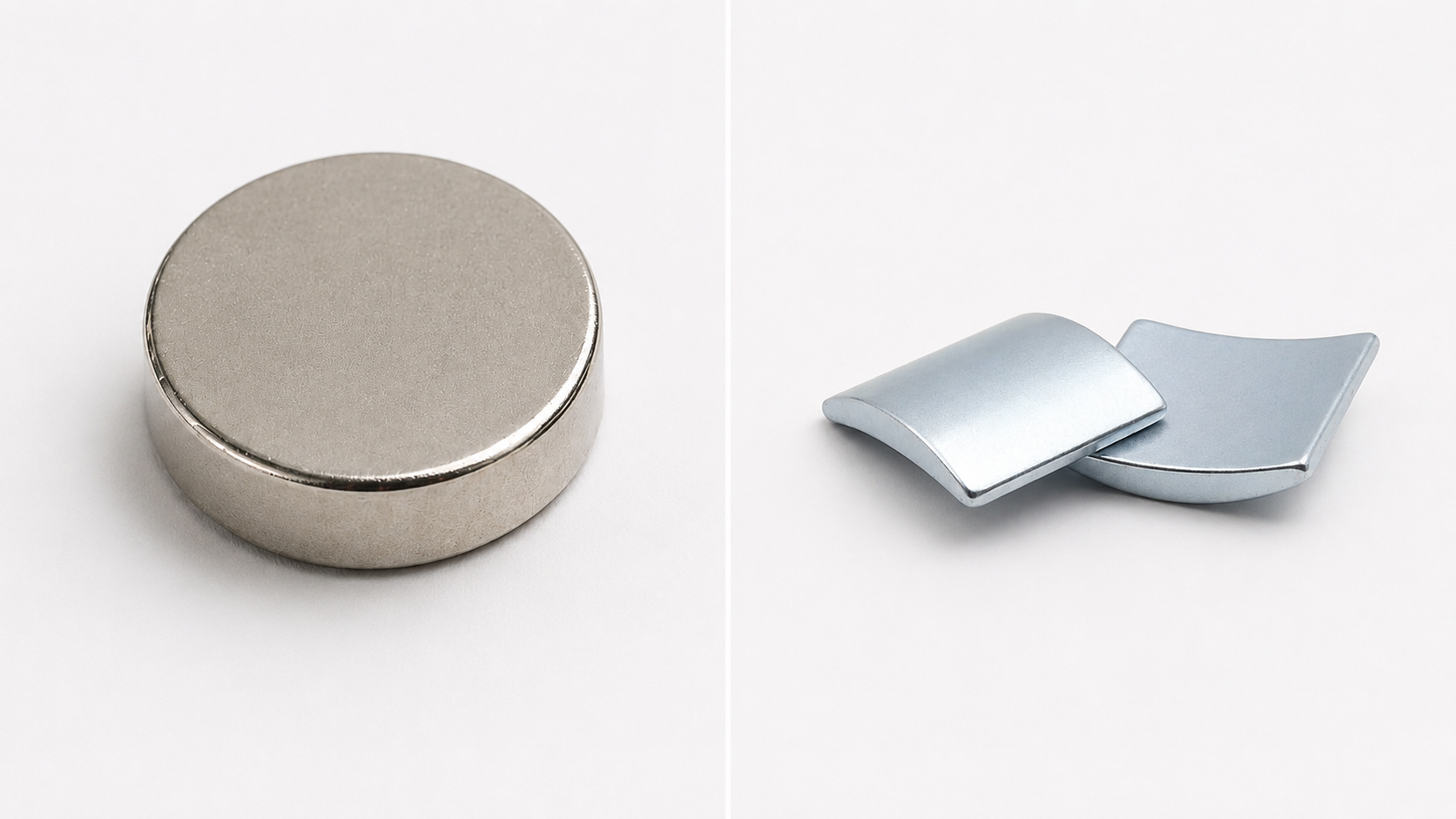
Samarium cobalt (SmCo) and neodymium iron boron (NdFeB) are the two families of rare earth permanent magnets.
They are both sintered alloys with exceptional magnetic properties relative to their size, however they are not interchangeable.
Selecting the wrong one for your application will result in either unnecessary cost (SmCo where NdFeB would perform) or premature field loss, coating failure, or assembly failure (NdFeB where SmCo was the correct answer).
This guide gives you everything you need to make the right choice when choosing between the two.
Quick answer
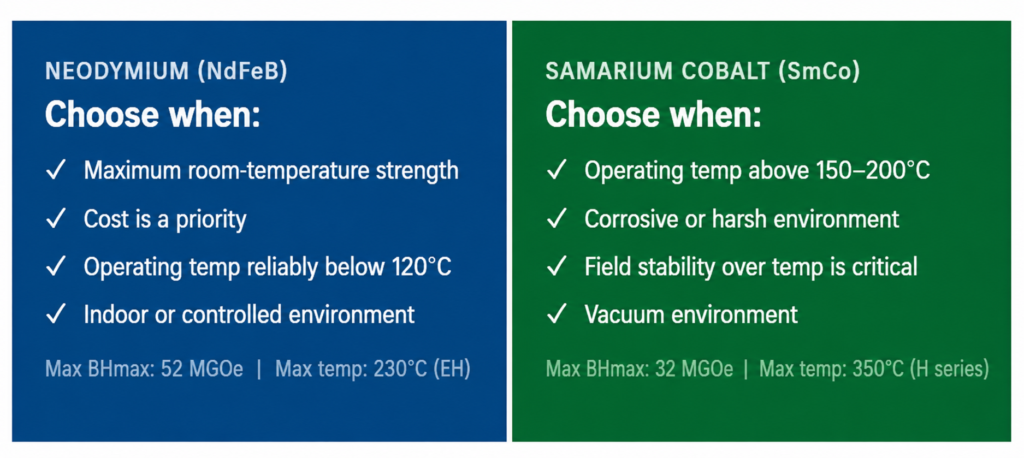
Use NdFeB when you need the strongest magnetic performance at room temperature and compact size.
Use SmCo when the application involves high temperature, corrosion risk, strong demagnetising fields, or field stability over a wide temperature range.
The fundamental trade-off
NdFeB is the stronger magnet at room temperature. SmCo is the more stable magnet at elevated temperature, in corrosive environments, and wherever field consistency over a wide temperature range is a design requirement.
The two materials do not simply occupy different price points – they have genuinely different performance profiles, and the right choice depends on what your application actually demands.
NdFeB dominates at ambient temperature. The strongest NdFeB grade (N52) produces a BHmax of approximately 52 MGOe — more than 60% greater than the best SmCo grade (SmCo32 at 32 MGOe). In any application where space is constrained and operating temperature is below 80–120°C, NdFeB produces more field from a smaller volume of material at lower cost. This is why NdFeB is the default choice for consumer electronics, general industrial holding, and most ambient-temperature applications.
SmCo takes over above 150–180°C. NdFeB’s temperature coefficient — the rate at which field strength drops as temperature rises — is approximately −0.09 to −0.13%/°C. SmCo 2:17’s temperature coefficient is −0.03%/°C. This difference compounds: by 200°C, an NdFeB-EH grade is approaching its design limit and operating with a significantly reduced field; SmCo 2:17 has retained over 94% of its room-temperature performance and is nowhere near its ceiling. Above 200°C, SmCo has no NdFeB competitor. Above 250°C, only SmCo is viable. At 350°C, SmCo 2:17 H series is the only rare earth magnet option.
Corrosion resistance is an important differentiator. NdFeB has a high iron content and will corrode rapidly without a coating in humid or wet environments. Proper coating selection (epoxy, PTFE, NiCuNi + epoxy) addresses this for most applications, but adds cost, dimensions, and complexity. SmCo 1:5 contains no iron and is inherently corrosion-resistant – used uncoated in most environments. In applications where coating reliability is a concern (food processing, offshore, downhole, medical), SmCo’s inherent corrosion resistance removes a significant point of failure.
Property comparison: NdFeB vs SmCo
The table below compares the two material families across the properties most relevant to industrial specification decisions. Highlighted cells indicate the clear advantage for that property. Where both materials have comparable performance or competing risks, this is noted.
| Property | Neodymium (NdFeB) | Samarium Cobalt (SmCo) |
| Max BHmax (room temp) ▸ NdFeB advantage | Up to 52 MGOe (N52). Best room-temperature field density of any permanent magnet material. | Up to 32 MGOe (SmCo32). Strong — comparable to N32 NdFeB — but NdFeB wins at ambient temperature. |
| Max operating temperature ▸ SmCo advantage | Up to 200°C (EH-grade). Standard grades (no suffix): 80°C. Dysprosium content increases with temperature rating. | Up to 350°C (SmCo 2:17 H series). Standard 2:17: 300°C. SmCo 1:5: 250°C. No dysprosium required. |
| Temperature coefficient (Br) ▸ SmCo advantage | −0.09 to −0.13%/°C. Field strength drops significantly as temperature rises. | −0.03%/°C (Sm₂Co₁₇). Best reversible temperature coefficient of all rare earth magnets. |
| Corrosion resistance ▸ SmCo advantage | Poor uncoated. High iron content causes rapid oxidation. Coating essential in all but the driest environments. | Excellent (SmCo 1:5 — no iron content). Good to very good (SmCo 2:17 — minimal free iron). Often used uncoated. |
| Coercivity (Hcj — demagnetisation resistance) ▸ SmCo advantage | High: ≥955 kA/m (standard). EH grades: ≥2388 kA/m. Achievable through dysprosium addition. | Very high: SmCo 1:5 ≥1194 kA/m inherently. SmCo 2:17 H series ≥1990 kA/m. No dysprosium needed. |
| Cost (approximate, equivalent volume) ▸ NdFeB advantage | Baseline. NdFeB is the lower-cost rare earth magnet for standard applications. | More expensive than NdFeB of equivalent size. Cobalt is a volatile commodity — prices fluctuate. |
| Machinability ▸ NdFeB advantage | Good. Can be ground, sliced, and drilled with conventional diamond tooling. More tolerant of machining. | Difficult. Extremely brittle – particularly SmCo 2:17. Requires diamond tooling, copious coolant, slow material removal. |
| Brittleness ▸ NdFeB advantage | Brittle (sintered ceramic) but more tolerant than SmCo. Chips under impact but handles well in production. | Very brittle – especially SmCo 2:17. Will shatter if allowed to snap together. Requires careful handling throughout. |
| Availability and lead time ▸ NdFeB advantage | Standard N grades are not subject to export license requirements. High temperature Neodymium grades, N40SH and above – require export license approval due to Dysprosium content. | All grades of SmCo are currently subject to export license requirements. |
| Supply chain risk ▸ Both have risks | Neodymium supply concentrated in China. Export controls a live concern (2025 onwards). | Cobalt supply concentrated in DRC. Cobalt market volatility affects price significantly. |
Samarium cobalt vs neodymium: temperature ranges
| Temperature | NdFeB status | SmCo status | Verdict |
| Room temp (20°C) | N52 ~52 MGOe (full performance) | SmCo32 ~32 MGOe (full performance) | NdFeB advantage: ~60% more energy product at ambient |
| 80°C (N-grade limit) | Standard NdFeB demagnetises. H-grade NdFeB required. | SmCo fully stable — <0.18% loss vs room temp | NdFeB needs temperature suffix from here |
| 120°C | N42H operating at limit. SH grade required. | SmCo fully stable — <0.3% total loss vs room temp | NdFeB grade options narrowing, BHmax trade-off increasing |
| 150°C | N42SH operating. Dysprosium cost significant. | SmCo — crossover zone. Performance broadly comparable | The crossover: SmCo becomes the more reliable choice |
| 200°C | N38EH approaching practical limit. Very limited grades. | SmCo 2:17 standard — excellent performance retained | SmCo clear advantage. NdFeB near ceiling. |
| 250°C | No NdFeB grade rated to this temperature. | SmCo 1:5 — rated to 250°C. SmCo 2:17 — still 50°C in hand | NdFeB not viable |
| 300°C | No NdFeB grade rated to this temperature. | SmCo 2:17 standard — rated to 300°C | SmCo only option from rare earth magnets |
| 350°C | Not possible with any NdFeB grade. | SmCo 2:17 H series — rated to 350°C | SmCo H series — no competitor in rare earth magnets |
Application-by-application material recommendation
The table below provides recommended material for common industrial and commercial applications, with the specific grade and rationale for each recommendation. These are starting points — always validate against your specific operating temperature, environment, and performance requirements.
| Application | Typically specified | Why |
| Industrial motors (continuous, <120°C) | NdFeB | NdFeB provides superior BHmax at ambient. Temperature-rated grade provides headroom. SmCo not justified on cost. |
| Industrial motors (continuous, >150°C) | SmCo | NdFeB approaches thermal limits above 150°C. SmCo 2:17 provides reliable performance with better field stability. |
| EV / traction motors | NdFeB | Space-critical, high-torque, significant thermal load. NdFeB-UH/EH provides competitive performance at lower cost than SmCo. |
| Precision sensors / encoders | SmCo | Field stability over temperature range is critical. SmCo’s temperature coefficient (−0.03%/°C) minimises measurement error across the operating range. |
| Consumer electronics | NdFeB | Room-temperature application. NdFeB far cheaper. SmCo cost premium entirely unjustified. |
| Consumer products / closures | NdFeB | Cost-driven. NdFeB adequate for ambient holding applications. |
| Medical devices (non-implantable) | NdFeB or SmCo | NdFeB with appropriate coating for most external equipment. SmCo where temperature or corrosion resistance is needed. |
| Medical devices (implantable) | SmCo | Established history of clinical use. Corrosion resistance and biocompatible coating compatibility. |
| Aerospace actuators / gyroscopes | SmCo | Field stability, thermal performance, vacuum/outgassing suitability. Many aerospace specs mandate SmCo by class. |
| Oil & gas downhole tools | SmCo | Sustained temperatures above 200°C. Strong opposing fields. Chemical environment. NdFeB not viable. |
| Offshore / marine applications | SmCo or NdFeB + coating | SmCo 2:17 inherently more corrosion-resistant. NdFeB + NiCuNi+Epoxy viable if cost is a constraint. |
| Linear actuators (ambient) | NdFeB | High Br for maximum flux density in air gap at room temperature. SmCo not cost-justified. |
| Stepper / servo motors (precision) | SmCo | Torque consistency over temperature critical for servo control accuracy. SmCo preferred in demanding precision systems. |
| High-temperature industrial sensors | SmCo | Operating temperatures above 200°C. NdFeB-EH approaches limit. SmCo H series provides margin. |
| R&D / prototyping (general) | NdFeB | Lowest cost for validation. Switch to application-optimised grade/material after performance testing. |
Get In Touch
Not sure which material is right for your application?